digital fashion, a guide for users
As the boundaries between our real and virtual selves become blurred, interactions with virtual fashion multiply. All the more so as the construction of our image proceeds more and more through the screen, the place of all encounters.
There are two ways to consider the abolition of the real/virtual border at the time of social networks and the announcement of the Metaverse. The first one, conceptual and worked by philosophers, invites us to put back this distinction in the intertwined history of social relations and technologies. The second is yours, woven from immediate negotiations and everyday practices: choosing a LinkedIn profile picture, switching to a private Instagram account, mechanically consulting your phone during the school fair. Did you post the New Year’s BeReal at 00:02?
Now, real/virtual interference is invading our existences even more intimately through digital fashion. As the name of the account “ThisOutfitDoesNotExist” created by Daniella Loftus sums it up very simply, digital fashion creates clothes that don’t exist other than as digital files. Their material nonexistence, however, doesn’t stop you from carefully storing them in your “virtual dressing room” and wearing them at your leisure in your Facebook photos, Instagram videos, online meetings and —very soon— while joining your friends at the latest trendy wine bar in the Metaverse.
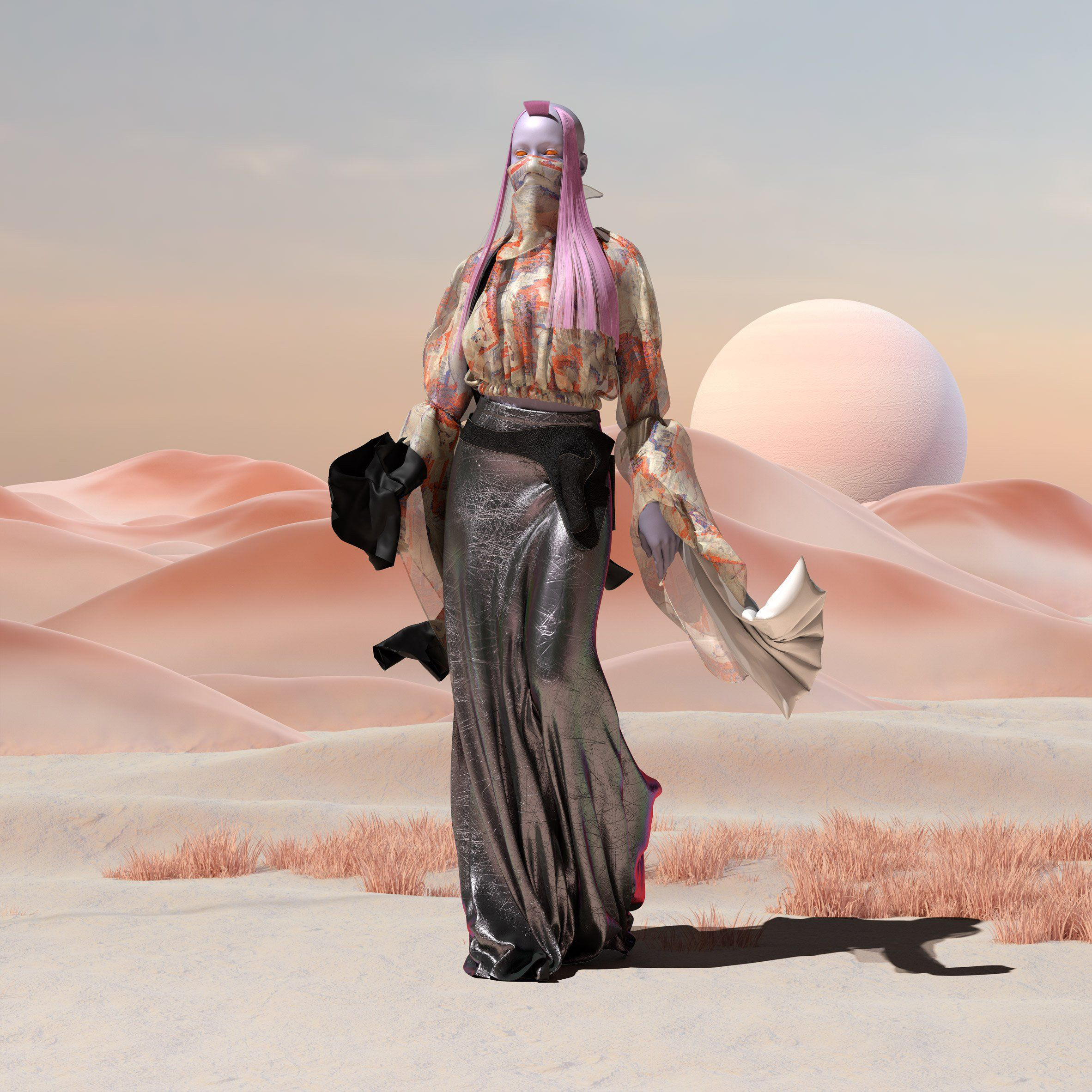
The Fabricant, digital fashion house
The paradox of digital fashion
Digital clothes— worn in digital photographs or videos— seem paradoxical at first glance. They can no longer be considered as “sensitive objects” in their own right. Indeed, whether it comes from fast-fashion or from an haute couture workshop, the garment is a set of sensitive know-how, material work, assembly techniques impossible to dissociate from the materiality of the finished product. Worn, the garment is a source of sensations, close to the body, which it hides or uncovers, and can be considered as a second skin charged with affectivity. On the contrary, the digital garment is deployed in the game of social appearances more than in the sphere of the sensitive. Its function is less to protect you from the winter weather than to catch the eye.
Economy of visual attention
Digital fashion is part of the visual “attention economy.” It is dedicated to producing a visual effect beyond the ordinary, both on a human being and on an online avatar. Although technological developments sometimes make it difficult to discern in a photograph whether a garment is real or digital, the majority of the pieces have a common style: the shapes are original, exaggerated, and have shiny elements or iridescent colors to increase the luminous effects. From this point of view, digital clothing is also a strategic element intended to amplify the visibility of its wearer on social networks.
Social markers, identity markers, cultural heritage and futuristic projections, digital jackets and dresses are free from physical constraints. Infinitely expandable, they adapt to your size. Easy to put on, no more zipper problems. Waterproof, impossible to stain, the colors never fade in the wash - digital fashion may be paradoxical, but it is convincing. Especially if, like me, you dream of a long evening dress (in wild silk), embroidered (with diamonds), multicolored and bright. Digital fashion is also exempt from the scarcity and price of materials. The dream is within reach.
Digital clothing or phygital clothing?
From a phenomenological point of view, digital fashion renounces a procession of bodily sensations linked to clothing: support, restraint, weight, touch, noise of the material, scent. However, the body is not “absent” from digital fashion; on the contrary, it must be present. A digital garment can be “integrated” manually on photographs; however, the majority of applications and fashion houses offer body recognition algorithms. The garment can thus be worn and presented in an instantaneous way— in video for example. The results are variable depending on the applications used and the initial quality of the digital modeling, but they always produce interesting visual effects, from perfect illusion to chaotic oscillation around the wearer’s body.
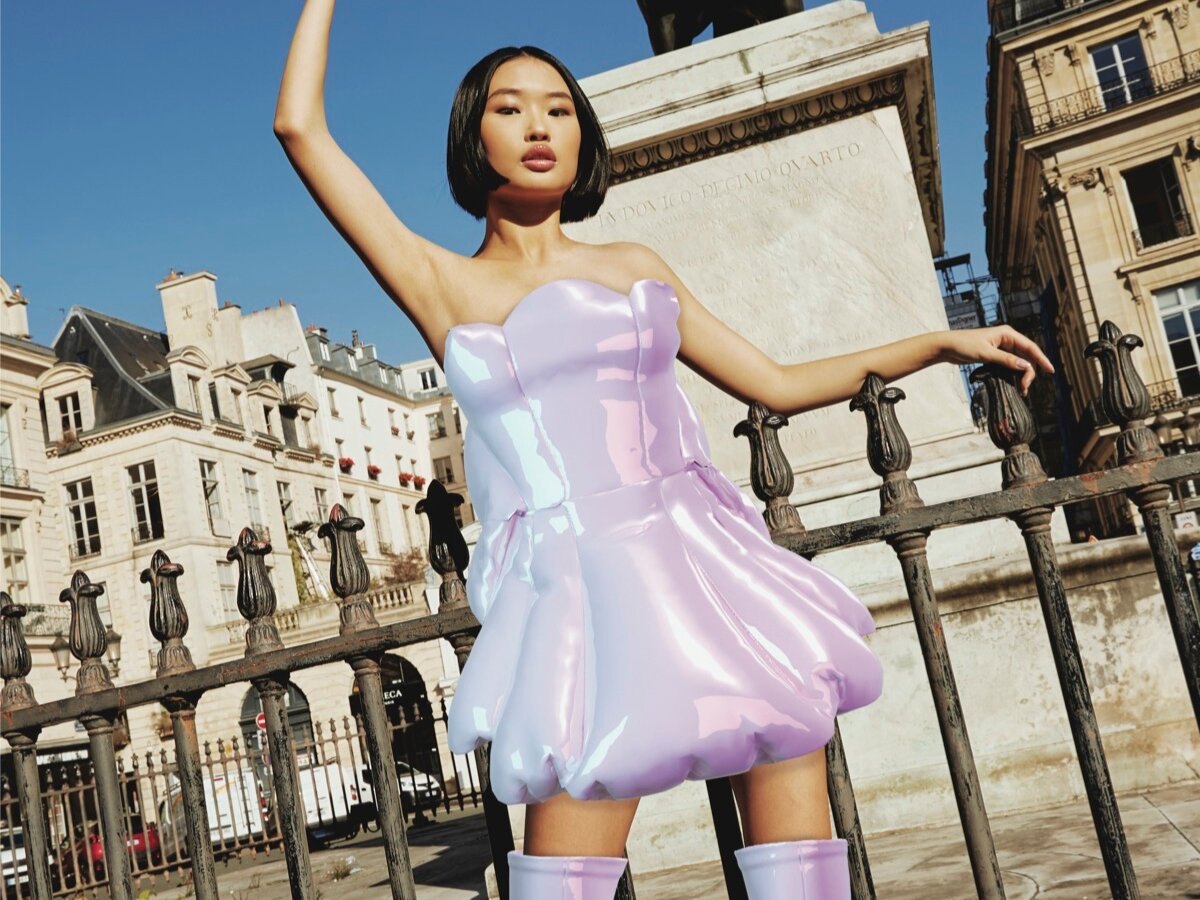
Republiqe digital clothing
This is where the body comes into play: you have to learn how to wear digital fashion. Postures, slow movements, precautions to take when crossing the legs. The first experience can be as pleasant as trying on an 18th century corset. At least you will have the impression of playing a fashion model or a doll— with yourself, at first.
Sensitivity of the body and sensitivity to the algorithmic image: digital fashion is not entirely free of the physical. Therefore, it is also called “phygital” to pay tribute to its dual nature. Let us note that digital fashion fits into the general context of the “operative image” as defined by Jean-Paul Fourmentraux. The digital image produced by and for the networks is a set of technologies invested by users who, through their practices, subjectivize pre-existing technical devices. In other words, digital fashion has created uses, from the body recognition tools and design software that already exist. In this sense, the images it produces are “operative images” that have taken over the devices in order to transform them into increasingly widespread uses.
The creators of digital fashion
The relative freedom from physical constraints— which relates to consumer practices and current technical tools— represents a large space for creativity for designers. Digital modeling software, initially intended for pattern making, has become a fashion workshop in its own right. The experiments are about textures, lights and shapes; they allow us to manipulate all the physical parameters, such as gravity, light and transparency. If the clothes themselves radiate a very digital light, they can also be integrated into the physical context of the wearer by varying the intensity of the light worn or by taking into account the wind speed. In the digital world, a pink dress with ruffles is less a dress than a computer program. Some high-quality pieces are already breathtaking as the work on the fabric’s draping perfectly calculates the visual effects of some dance steps.
Origins, steps and discourse of digital fashion
Shaped by the world of video games and the development of social and virtual realities, and linked by the metaverse to transhumanist currents, digital fashion is currently a part of high fashion. It mimics its vocabulary, its standards, its calendar and its major events. For example, the first “Metaverse Fashion Week” took place in the virtual universe Decentraland on March 24, 2022. In addition, a large number of digital fashion designers come from fashion schools and work within both fields.
Closely followed by the big fashion groups, the development of digital fashion has seen the birth of apps (DressX), fashion houses (BlancdeBlanc) and sales sites (DressX, TheDraup). A blockchain platform called “Aura”, set up by the luxury industry, aims to master the NFT technologies of digital fashion. Partnerships with the video game industry, like Gucci and Fortnite, allow digital fashion to become part of young consumers’ habits. Major digital companies, including Snapchat, and the startup ecosystem Fits.me are also pushing technology forward toward digital fitting rooms and algorithms dedicated to fashion.
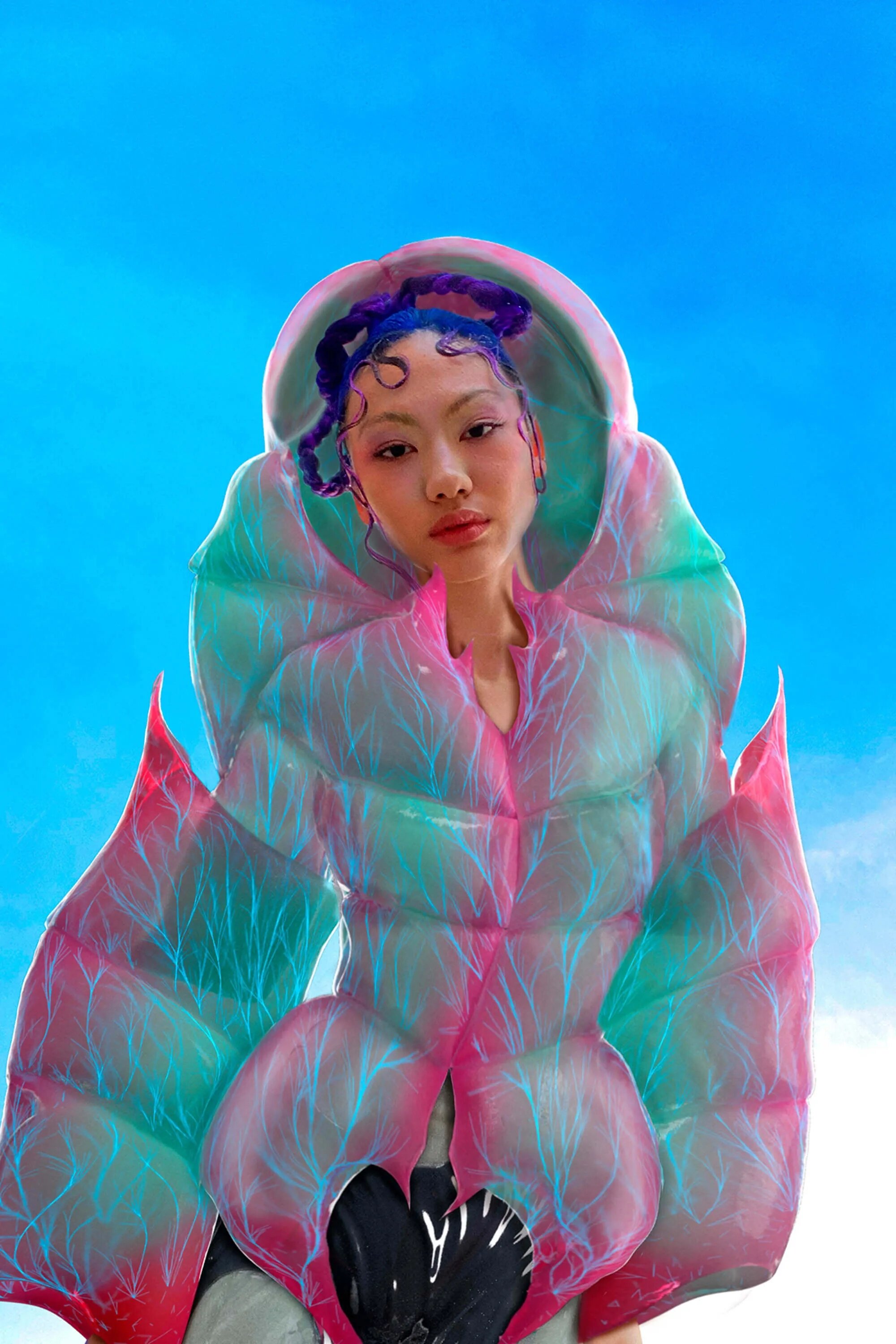
Auroboros
The “cutting edge” aspect of digital fashion also allows these players to create engagement on social networks. The community of consumers expands as the discourse gains visibility: originality, creativity, democracy and accessibility of digital fashion. Presented as an ecological solution to the overconsumption of fast fashion, digital fashion seems destined to become a real economic sector. For the moment, digital fashion is essentially communicating to the future. It is even an “aesthetic of the imagination of a digital future,” according to the director of partnerships of a fashion house. This is connected with the rise of “identity buying” which allows us “to open up the ways of presenting oneself and acting in the social world.”
Self-performance and the cyborg hypothesis
It is this reference to identity and “self-performance” that seems to best characterize digital fashion. The self-image in digital spaces is a doubly “brilliant” image: it feeds on the light of the computer and on the “will-to-please,” defined by the researcher Barbara CarnevalI as a search for visual attention. The digital, luminous and iridescent clothing participates in a self-definition in this perspective. The performance mode is also interesting to describe digital fashion. Wearing a digital garment seems to be an ephemeral act, but once the photograph is published on social networks or the avatar is created, it becomes part of the long term. On the social network Instagram in particular, the images are part of a linear thread that presents the life of an individual over several years. The digital clothing participates, with all its physical non-existence, in the social life of an individual.
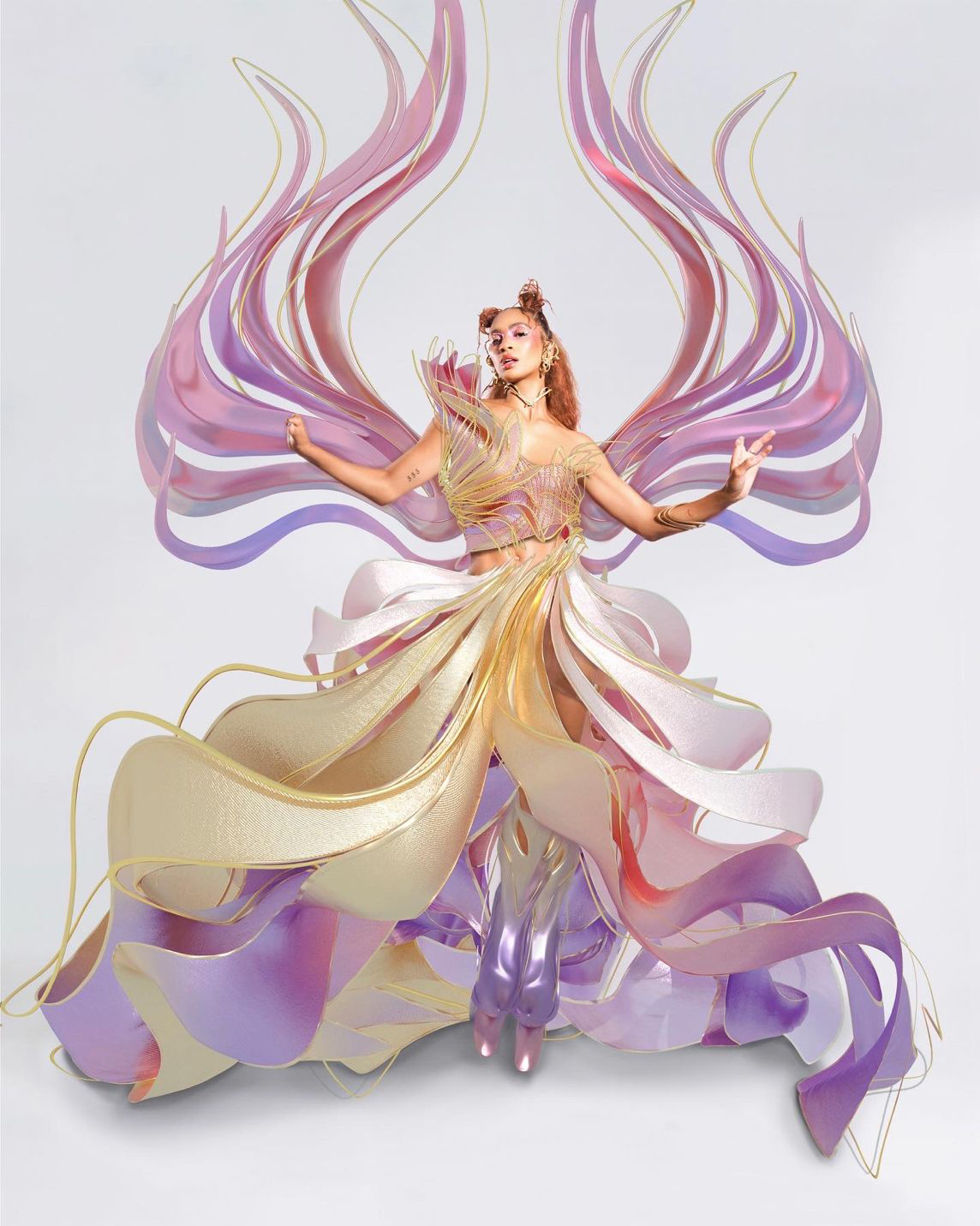
Xtened Identity's 'Love Warrior' NFT Collection
Digital fashion is ultimately part of a desire to control one’s image (individual appearance, determination of the frame and elements) and the reception of the image by others (visibility monitoring, social extimacy and algorithmic popularity). Digital fashion resorts to digital shooting devices, where the distance to the camera allows us to be both the one who sees and the one who is seen. In this way, it acts as an “overdetermination” of the image: it allows the addition and modification of the clothes worn on a video or in a photograph. This overdetermination can take place instantaneously but also retrospectively, in the sense of a wider control of the self-image. It is the same for avatars, which allow a form of affective auto-identification based on the principle of extension and redoubling of oneself.
This hybridization of sensibilities, whether it comes from a digital photograph or from the relationship with an avatar, is to be put in parallel with the hybridization of bodies. The Cyborg Manifesto by Donna Haraway opens up interesting considerations on this subject: the variegated, sometimes invasive forms of the digital fashion could be similar to the cyborg conceptual paradigm. The meeting of a real image of the body and the modifications due to a digital garment produces, according to the definition, a cyborg— “a condensed image of the imagination and the material reality joined together.” It is perhaps this last definition that would replace the distinction between real and virtual worlds in the case of digital fashion. The digital garment as a digital file, a pixel cloud and a projection of oneself on social networks, informs us of an interesting dimension of the garment in general. It becomes as much a product of the senses as of the social appearances which motivate it, shape it and wear it in front of the world. Fashion is a creative management of this balance between sensibility and appearances— and digital fashion, its epigone, is well on its way to achieving effects of great quality.