fashion since tiktok
It’s always the same question: does fashion come from above or from the street? From social networks we should say in 2023, and more specifically from TikTok.Or how a media dictates its tempo in terms of trends.
Known foremost for its viral dances and punchy videos, the social media app TikTok has become a household name around the world. TikTok’s short, digestible pieces of content cater to a new social reality of shorter attention spans, breeding a constant demand for stimulation and an endless need to have media at our fingertips 24/7. In under less than five years, TikTok has reached 1 billion active users worldwide, and the growth of the platform has no end in sight. With such a large reach and continuing rapid growth, it’s become a major part of marketing strategies for many facets of consumer capitalism— especially fashion.
Gen Z– those aged 12-25 who make up nearly half of all TikTok users globally— is of particular interest to the fashion industry as they come of age and begin to make their own decisions about how to spend their money. It turns out they’re choosing to spend the most on fashion as an entertainment category.1 As a result, we’ve seen luxury fashion dip its toes into the platform, with runway show livestreams from Prada and Louis Vuitton, behind-the-scenes videos from Jacquemus and Balmain, and Gen Z-focused engagement strategies from Gucci and JW Anderson.
But what is most pervasive on TikTok is the user generated content (UGC) that heavily drives fashion sales and fashion trends. Because of TikTok’s UGC that feels more authentic, more honest and more community-minded, users have reported feeling a deeper connection to products than on any other platform, making them more likely to make purchases based on what they see on the platform, and overall, more inspired to shop.2 Compared to highly curated and polished Instagram feeds, TikTok is bright, loud and unapologetically messy, and its success is forcing a major aesthetic shift. It’s changed users’ relationship to fashion, making it difficult to predict trends, and seemingly impossible to define style of the current era. It’s also created a world of fashion that appears devoid of meaning, and faster than ever.
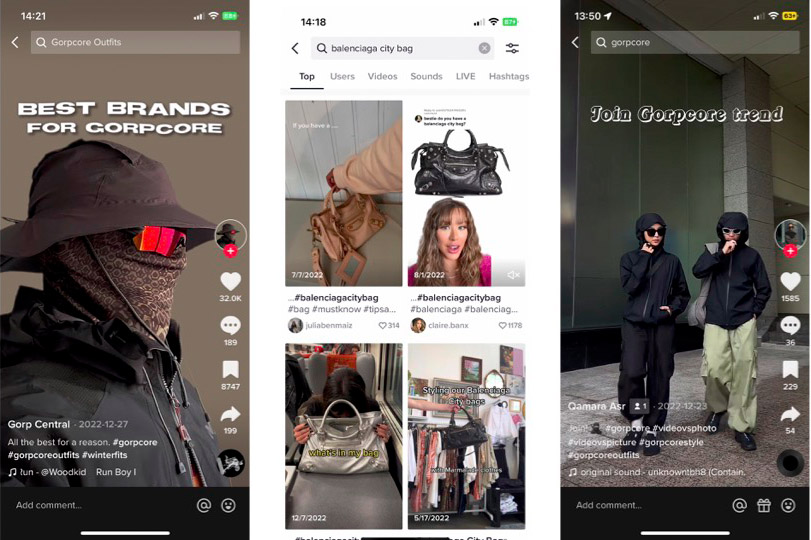
Gorpcore, Viral items, Gorpcore
The focus on community and authentic-feeling UGC created on TikTok has resulted in a change in the formation of fashion trends making TikTok a symbol of the fashion world reversed. Until now, the cycles of fashion have long been illustrative of Thorstein Veblen’s trickle-down theory developed in his 1899 book, The Theory of the Leisure Class. Veblen explained that fashion was a key element used by elite classes to signify their higher status. For a long time, this remained true, and as a result, brands and retailers catered to the needs of the upper classes. Fashion trends were made for and worn by the elite first, slowly “trickling-down” into the lower classes. Once the trends reached the masses through accessible fashion retailers and counterfeit markets, they became passé. New trends were formed at the top, out of reach for the lower classes, and the cycle continued.
This system sustained the fashion industry since time immemorial, but with the rise and influence of TikTok, it has in many ways been turned on its head. The formation of trends is now in the hands of TikTok creators, who develop their own sets of microtrends and dictate what is popular in fashion. These microtrends are nothing like what we’ve seen in the past, and they’re so niche, it’s almost hard to believe they’re real: “Gorpcore” looks to functional, outdoor wear and technical brands; “Balletcore” takes style notes from dancers on and off stage; “Abercrombie-core” celebrates the Y2K American mall brands many of us thought died long ago. These are not like the subcultures and style tribes that have defined past generations— they’re purely aesthetic, fast moving, and devoid of much meaning.
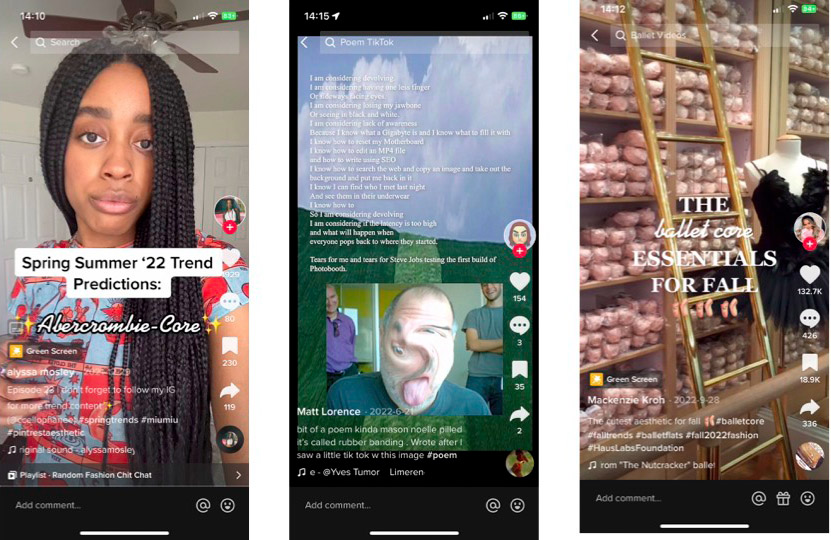
Abercrombiecore, Corecore, Balletcore
Although not rooted in fashion, one aesthetic trend that has become popular on TikTok is “Corecore”. Playing off the “-core” suffix of various TikTok trends, these are poetic, meme-like videos that stitch together images and clips about living in the 21st century to put forth a sense what defines our time, often pointing out the faults in contemporary culture by tying together the hyper consumption and fast pace of TikTok trends with other political failures. These Corecore tagged videos originally held political messages such as anti-industrialism and environmentalism that define the politics of Gen Z. However, some creators like Matt Lorence (@littlefreak26 on TikTok) argue that Corecore has shifted away from politics toward aesthetic catharsis, reflecting the anti-intellectualism of Gen Z in a much greater way. Lorence specifically highlights that, removed from their original ideology, this aesthetic movement falls flat, folding into the vast world of meaningless aesthetic trends found and developed on TikTok.
This is also true for the way that fashion is taken up on the platform, reflecting a great shift in relationships to subculture and style. Where trends were once often associated with culture and ideology, they now fall short of anything more than a desire to consume viral items found on TikTok. We’ve seen a resurgence in popularity of the Vivienne Westwood Crystal Orb necklace and the Balenciaga City Bag, and a massive demand for the Miu Miu satin ballerina flats and Balenciaga BB0201S sunglasses. Overall, it’s about specific items rather than a total definitive look. Just as with the anti-intellectualism of Gen Z explained by Lorence, the rise of each trend quickly turns meaningless with little connection to anything bigger than an affinity for a particular short-lived aesthetic moment.
TikTok’s microtrends are so discrete and fast moving that they’re nearly impossible to predict, at least in the sense of traditional trend forecasting as we once knew it. Gone are the days of deep data analytics and global assessments by professional trend forecasters. In fact, trend forecasting on TikTok has become a trend in and of itself. Creators post “trend prediction” videos stating what they think will be popular in the upcoming seasons, based on what seems to be absolutely nothing in particular. While some of these creators claim to have backgrounds in fashion forecasting to back up their predictions, others seem to pluck these trends out of nowhere, muddled together from various cultural spaces that otherwise feel disconnected to develop some kind of new “-core” that make older generations scratch their heads. It is these videos that seem to drive the microtrends: prediction videos that go viral are followed precisely and adapted immediately, rather than the sometimes years-long wait that traditional fashion forecasting held. But just as quickly as they are adapted, these trends fall away to make room for the next one. While this has a strong effect on fashion marketing as we know it, it also effects the way we may be able to define this generation of fashion— that is that it is rather undefinable at all.
But does being a generation that is defined by style matter? That trends are formed from the bottom up on TikTok, and UGC is selling more than high budget advertisements indicates that this is a generation who demands to be themselves without following what the industry dictates. It is these microtrends and communities formed on TikTok indicate a need to do away with fashion’s elitism and recognize that a system formed on markers of status and perfectionism is no longer sustainable. Perhaps this fast-paced, bricolage of aesthetics fumbled together by viral items and vague terms is precisely what defines this generation of fashion after all. Furthermore, maybe all of this it isn’t a reflection of anti-intellectualism, but an opportunity to disconnect from the politics of everyday life. Perhaps fashion must continue to embrace the memeification of itself on the platform, do away with polished predictability and lean in to TikTok’s messiness in bigger ways if it wants to find success among this key market. Think about the viral TikTok trend where creators humorously imitate the Balenciaga runway walk and style from their SS23 RTW show, a show that loudly spoke to climate change, war and generational despair. The takeaway for TikTok creators here was not the political messaging of the show, but an opportunity for humour— because maybe the impending doom of our time is utterly too much to constantly think about. What is clear is that TikTok is redefining the terms of what it means to participate in the world of fashion, and whether those terms can be defined or not, TikTok is begging for fashion to keep up.